How A Former Fashion Model Designed Concealed-Carry Running Shorts For Women

In Georgetown, Texas, back in 2002, college student Rachel Cooke went for a jog during a winter break visit to her parents’ home just north of Austin. She was near the end of her regular four-mile run and was last seen just 200 yards from her family’s house. To this day nobody knows what happened after that, because Cooke was never seen or heard from again.

More recently, in another part of Texas just outside Dallas, avid runner Amy Robbins never really used to worry much about harassment or worse when she was out training, despite reports of female runners being victimized as Cooke surely was. “I saw that this was happening, but it never really got my attention,” she said. “The stories of women being attacked and murdered were always on the back page. I’d heard some stories but I always felt completely safe.”

Then one day she was out training for a marathon when something did happen to her. A pickup truck full of guys went past her, then turned around and returned. She had a few moments of terror, but she was more fortunate than many others. “I was lucky,” she said. “I was harassed and catcalled and followed, but nothing worse.” While physical attacks and murders of women runners are rare, they obviously do happen. There’s about one such murder per year on average, but related disappearances and lesser attacks are difficult to find numbers for. Meanwhile, fully 43% of women report some form of harassment while running, according to Runner’s World.

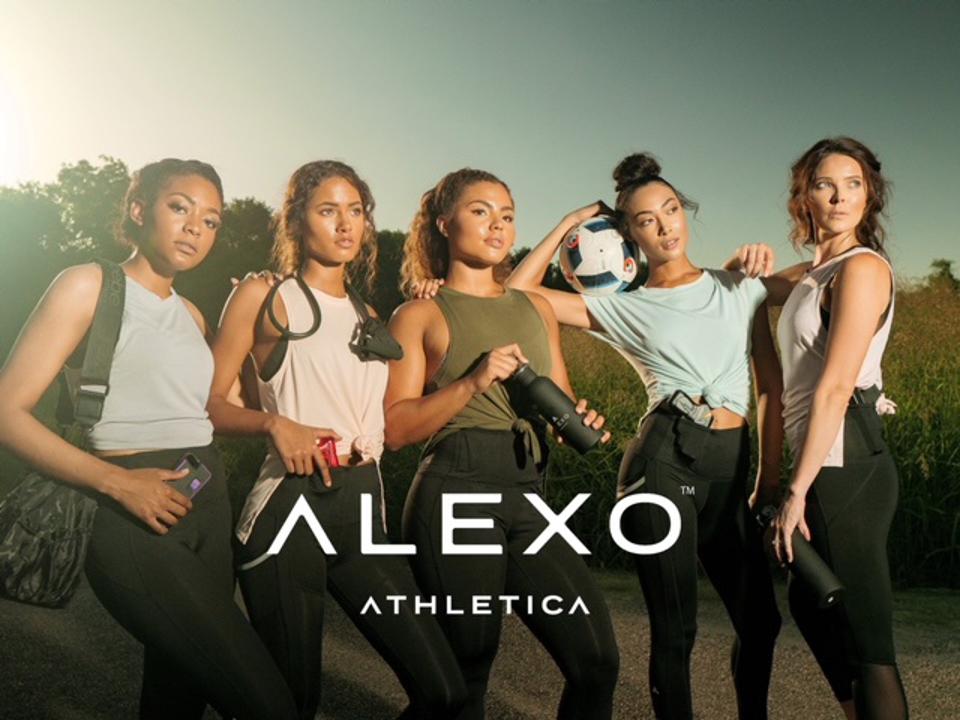
Robbins decided to do something about it. In 2017, she launched Alexo Athletica, her active-wear startup focused on producing women’s workout garments designed specifically for carrying self-defense tools, including concealed-carry handguns. “It was hard to get backing, because we’re disrupting a few different industries,” she said. “So my husband and I put our own money into funding it.”

It’s a bet that’s paid off so far. “We sold out our initial shipment in pre-orders,” said Robbins. “Year on year, we’ve seen double- and triple-digit growth. Last year we had 200% growth even though we were only in production for seven months because of the pandemic.” Alexo remains a bootstrapped operation today, although Robbins says she’d consider outside investment for the right kind of growth opportunity.

Her first product was leggings catering to runners and walkers. She focused on keeping them fashionable and functional, with a specially-designed wide and heavily elasticized waistband with multiple built-in pockets for secure carry. She’s since expanded her line with shorts, skirts and joggers, as well as specially-designed tops and jackets to help with concealed carry.

Along the way, Robbins has had to overcome some serious business difficulties. “I love talking about the challenges, because they’re the kinds of things every business owner has,” she said. “We had a U.S. manufacturer steal our money and not deliver our product, and we had to scramble to find a new supplier. We’ve had to deal with defective product—you can send that back, but then you can’t get replacements right away. We beat back a trademark threat from a big-dollar corporation. But I’m glad we faced those things. It forced us to pivot, and it built our confidence when we overcame them. I encourage other business owners not to give up!”

Alexo’s offerings have proven extremely popular, and not just for working out. “80% of my customers wear them whether they’re working out or not, to help with concealed carry,” Robbins explained. Functionality is clearly the main driver there. Karen Hunter, a firearms instructor, Range Safety Officer, and writer for a variety of firearms magazines such as Personal Defense World and Ballistic, is an enthusiastic Alexo customer for that reason. “I love them because when I’m carrying, they don’t move,” she explained. “My gun stays put. And I have room for extra magazines. I’m a big proponent of on-body carry, because otherwise an attacker can take your gun away from you. These keep it at your core, in the safest spot, where you can always get to it. And Alexo products last—I got my first pair three or four years ago and they’re still in great shape.”

For Robbins, it goes beyond concealed carry. “When I started the company, I realized it wasn’t just about resources for clothing,” she explained. “I wanted to help people on this journey to self-reliance, and give them resources for three pillars: mind sharp, body strong, and armor.” She makes it clear for that last point that while concealed firearm carry is right for some women, others may prefer to carry non-lethal protection like pepper spray or a taser.

She has other big things planned. The first is her launch of a men’s line this year, which offered its own challenges. “You guys are tough to design for!” she said. “You carry heavier weapons, and you want a lot more flexibility with where and how you carry them.” The second is a partnership with Springfield Armory, the iconic and popular producer of pistols and sporting rifles, to begin work on a collaborative clothing collection this fall. “Inspiring both new and existing gun owners is something we strive to do every day,” said Stefany Reese Toomer, Apparel Design and Merchandising Manager at Springfield Armory. “Through our partnership with Alexo Athletica, we hope to encourage a self-reliant lifestyle for everyone.” Added Robbins, “It’s an honor to partner with a company that has recognized the new direction and demographics of gun ownership, and we are launching our first collaboration this fall with a full men’s and women’s line.”

The demographics element is something Robbins sees as one of Alexo’s biggest strengths. “We’ve been super-fortunate,” she says. “Concealed carry is up 500% since 2007 for women. There are eight million new firearm owners in the U.S. in the past year, and 40% of them are women. I want to make sure we reach that new market segment.”

She’s had some help along the way. “Being a female founder in a very male-dominated industry has always been intriguing,” said Robbins. “Men are very supportive, but they want to see me do the hard work and prove myself. When I do, that makes collaborating with them easier. I’ve worked with so many amazing men, and many of them have become my mentors. They’ve been so helpful with what I want to do, which is to give back and help other women in this space.”

Source: Forbes
How to Be a Beach Volleyball Player?

Do you think you have the stuff to be a sea shore volleyball player? Being an incredible part in the sand doesn’t need such an indoor encounter, indeed indoor propensities should be broken.

In case I’m acceptable at indoor I will be acceptable at beach volleyball, isn’t that so?

Nothing could be further from reality. In the event that you are acceptable at indoor that implies probably that you are accustomed to playing one position and playing it well overall. You are additionally use to pivots and having 5 others around you to help burrow balls. It resembles instructing a golf swing to a baseball player, they make some harder memories learning than an apprentice since they need to bring an end to the propensity for what they are use to.

What are the distinctions from indoor volleyball to sea shore volleyball?

Other than the undeniable contrasts of being in the sand and just having 2 individuals for every group you likewise have significantly greater duty. You can’t dominate matches if the lone thing you can is spike the ball hard. Presently everything relies upon how well you can pass the ball before you find the opportunity to hit. Indeed passing is the solitary likeness between the 2 games. On the off chance that you can pass you will do approve.

You can’t have a powerless point in your game on the grounds that the rival group will see it and gain by it to win each point. With the off chance that you can’t pass you will get this show on the road each ball. In the event that you can’t set, at that point your accomplice will get served all day since they realize you can’t give him spread to hit. Indeed hitting the ball hard is the most straightforward activity and everybody can do it so it gives you no preferred position

Guide on Football Rules and Regulations

Football Rules

There are 17 rules that govern how the game is to be played so that it is fair to all players taking part in a game. The most basic rule is that a player needs to move the ball towards the opponents’ goal line and away from his/her own using any body part except the hands and arms. But what are the main rules and regulations of football? The Laws of the Game were created by the FA in 1863 when there were just 13 rules.

Guide on Football Rules and Regulations

Rule 1: The field of play

The pitch of the football must be a rectangle, marked with touchlines, goal lines and fields, half way, center circle, penalty area, spots, arcs corner arcs and flag posts. The short edge is the touch line while the short edge is known as the goal line. A half line divides it into two equal parts in the center of the field. All of these are required to mark the target areas, center circle, penalty area and corner arrows with a flag on each corner. The acceptable dimensions of a football field are 90- 120 mm in length by 45-90 mm in width.

Rule 2: The ball

The ball must be made of valid material. The diameter of the ball used in the game is 68-70 cm. (27-28in), weighs between 410-450g (14-16oz) and must have an internal pressure of between 0.6 and 1.1 atmospheres at sea level. It can only be replaced by the referee.

Guide on Football Rules and Regulations
Photo by Mica Asato on Pexels.com

Rule 3: Player & Equipments

These 11 players that make up the starting line-up usually includes one goalkeeper, four defenders, three midfielders and three forwards. The number of defenders, midfielders and forwards is subject to change depending on the formation used by the coach for each game.

Players are found to be wearing shin pads, football boots (sometimes called studs or cleats), and a predetermined team kit (which includes jerseys and shorts). On the other hand, the goalkeeper has to wear a kit that does not fit with any of the team’s kit on the pitch, that is, the goalkeeper is always able to wear a unique kit. It protects the body.

Rule 4: Scoring

Scoring in football is pretty straightforward. To score goals, the team needs to keep the ball within the opponent’s goal. In order to score a goal, the ball must cross the goal line completely.

Rule 5: Substitutions

The main part of football games in substitutions player A manager/coach can substitute players at any time during the game but the number of substitutions that each team can make is limited to a maximum of  3 players.

Rule 6: Football Penalties

If both teams are unable to separate themselves, a penalty shootout is done at the end of ‘extra time’. For each penalty shootout, each team has to select 5 players.

Rule 7: The Referees

Each match of football consists of a team of four referees who assign the game. One referee actively participates in the field game and with the help of two assistant referees, also known as linemen. The fourth referee is referred to as the ‘fourth ial ficial’ and currently maintains and manages outside the field, listening to the arguments and objections raised by the coaches of both teams, with staff and coaches from both teams.

Rule 7: The Extra Time

Extra time in football is 30 minutes long and each 15 minutes is split into two, with a two minute break at the end of the first part of the extra time. If the teams are still level at the end of the extra time, the winner is decided by a penalty shootout.

Rule 8: Football Fouls and Cards

Penalty cards are used in many games to warn, scold or punish a player, coach or team official. And penalty cards are commonly used by referees or umpires to indicate that a player has committed a crime. The officer will place a card over his or her head while looking at or displaying the player who committed the crime. 

This action decision is language-neutral for all players, as well as viewers and other officials. The color or shape of the card used by the officer applies to the type of crime or the severity

and level of punishment that indicates. The yellow and red cards are the most common, usually indicate, respectively, precautions and dismissals.

Volleyball Information: History, Rules

Volleyball is a group sport wherein two groups of six players are isolated by a net. Each group attempts to score focuses by ball touches the ground of the opponent’s court under sorted out rules. It has been a piece of the official program of the Summer Olympic Games.

Here is basic and important volleyball information that you must know

Volleyball History

The sport of volleyball initially called “mintonette” was introduced in 1895 by William G. Morgan after the development of b-ball just four years prior. Morgan, an alum of the Springfield College of the YMCA, structured the game to be a mix of the ball, baseball, tennis, and handball.

The hostile style of setting and spiking was first exhibited in the Philippines in 1916. Throughout the years that adhered to, it turned out to be evident that standard principles were required for competition play, and in this manner, the USVBA (United States Volleyball Association) was framed in 1928.

Basic Volleyball Rules and Requirement 

Here are some main volleyball rules and requirements

  • the main goal of the game is to bat the ball with the hand or clench hand in a way that it traverses the net and arrives at the adversary’s court and contacts the ground or if the rivals neglect to toss the ball back inside three contacts.
  • If the ball touches the ground of the opponent’s court, the respective time wins a point.
  • There are five sets in one game, if the team wins three sets out of five then the team wins the match.
  • One volleyball match has a limited time of 60 minutes for competitive volleyball and 45 minutes for social volleyball.
  • The volleyball court is 9m wide and 18m long and divided into two parts equally.
  • The net is kept in the center of the court and eight of 2.43m for man’s tournament and 2.24m for women’s tournament respectively.
Design a site like this with WordPress.com
Get started